
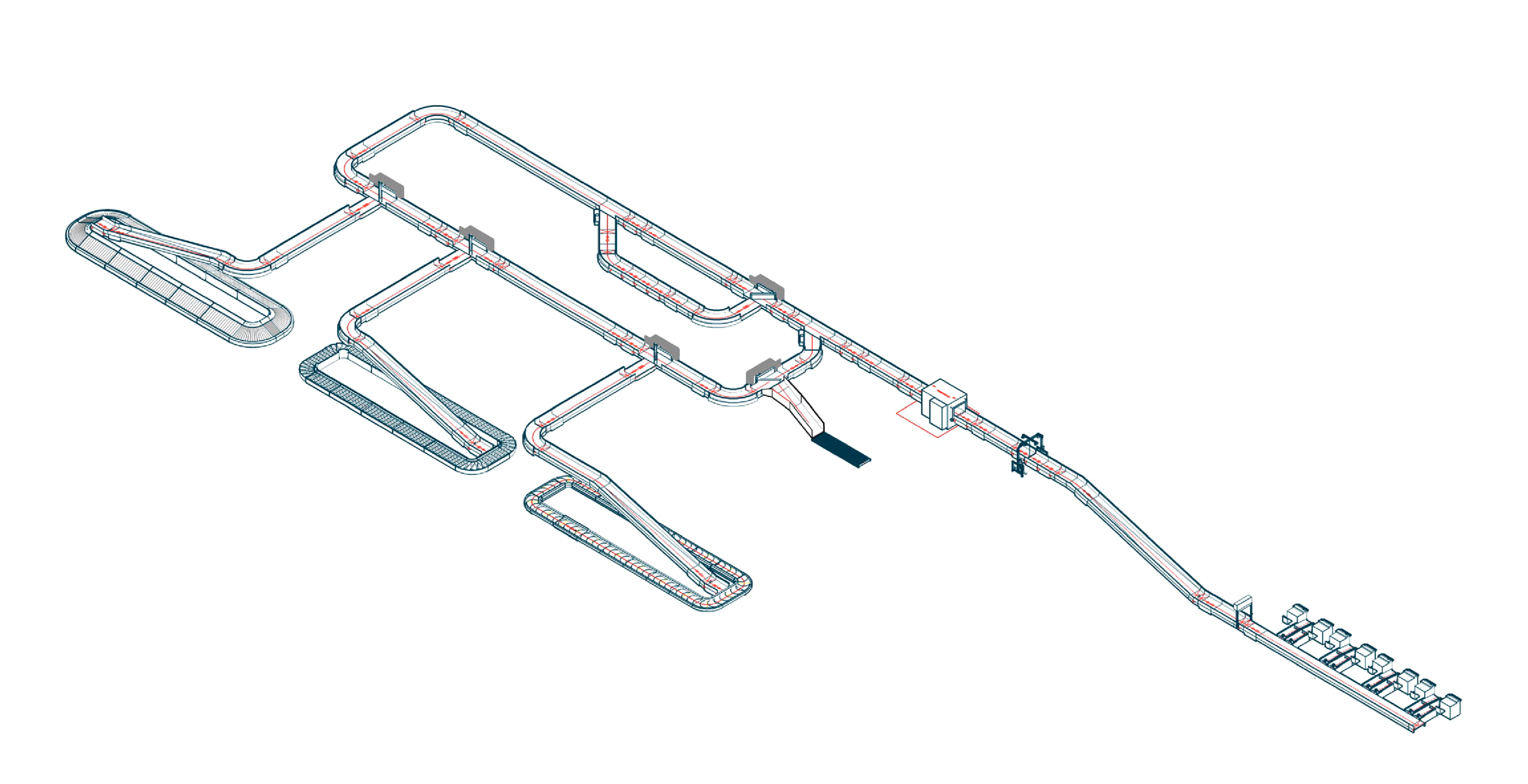
These ten key BHS products are intended as a starting point for you to review our comprehensive range of baggage handling systems and assist with planning and general discussions.
Ansir Systems designs and manufactures specialised baggage handling products engineered for reliability, efficiency and seamless integration within modern airport operations.
Our Products
Check-In Conveyor
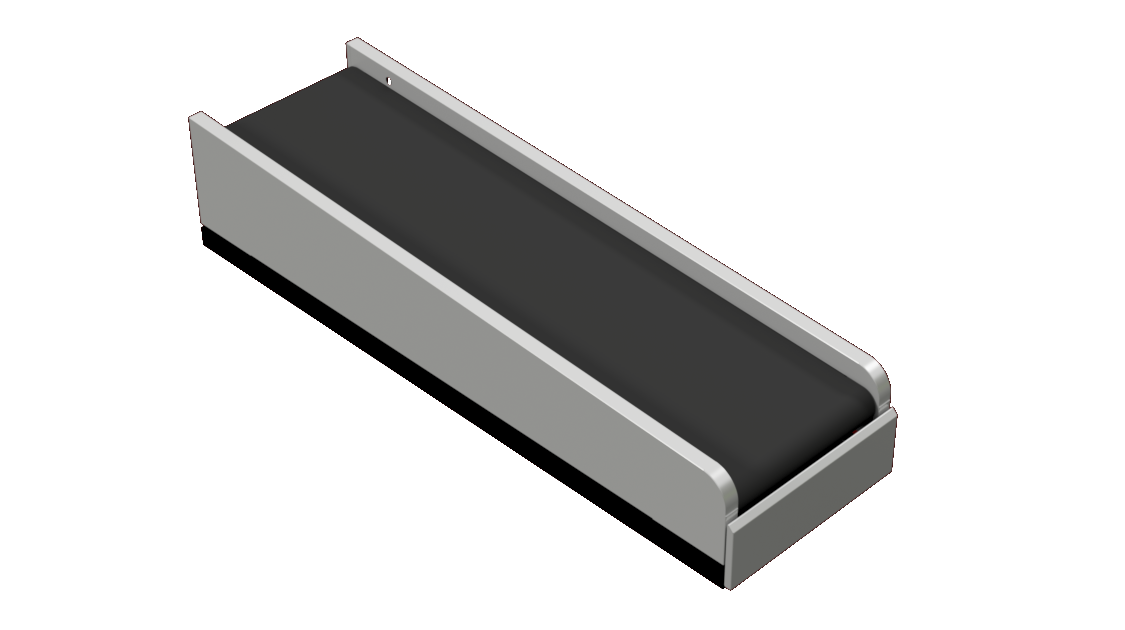
As the first point of interface between passenger and baggage handling system, the check-in conveyor must be safe, reliable and functional. The check-in conveyor is designed to weigh, label and dispatch baggage onto the collector / take-away conveyor without the need of manual lifting by the check-in operator.
Transport Conveyor
The transport conveyor is designed to transport baggage throughout the terminal smoothly and efficiently. It is designed to handle product horizontally and at any degree of incline / decline up to a maximum 18° angle where elevation changes are required.
Metering Conveyor
The metering conveyor is generally used as a queuing conveyor prior to conveyor junctions, merges or places where accumulation or separation is required. The conveyor is designed to cope with frequent stop /starts.
Merge Conveyor
A merge is a belt conveyor with a 45° angled connection edge that enables the merging of two conveyor lines. Typically used with additional sorting conveyors they provide for a smooth flow of baggage from one line to another.
Crescent Pallet Carousel
The carousel is designed to recirculate baggage on a continuous basis until it is removed from the conveyor. The crescent pallet carousel can be used as an arrivals carousel or make-up loop.
Overlapping Slat Carousel
The carousel is designed to recirculate baggage on a continuous basis until it is removed from the conveyor. The overlapping slat carousel can be used as an arrivals carousel or make-up loop.
Inclined Carousel
The carousel is designed to recirculate baggage on a continuous basis until it is removed from the conveyor. The Incline claim carousel can be used as an arrivals carousel or make-up loop.
Gravity Roller Conveyor
Non powered accumulation of baggage / product. The conveyor can be placed flat for manual movement of the bag along its length or slightly declined to let gravity slowly transit the bag.
Power Curve
The curve conveyor is used to change direction within the conveyor system and provide a smooth flow of baggage.
Plough Divert
The Fast Acting Belt Plough has been designed to handle and sort a wide range of products, with minimum impact to the bag during the plough divert operation.
Check-In Conveyor
As the first point of interface between passenger and baggage handling system, the check-in conveyor must be safe, reliable and functional.
The check-in conveyor is designed to weigh, label and dispatch baggage onto the collector / take-away conveyor without the need of manual lifting by the check-in operator.
Ansir check-in conveyors are designed with ergonomics and safety in mind. The tub load feature (available in the two and three stage design) has proven to reduce the amount of lifting the check-in agent has to perform and makes for simpler system operation.
Whilst the basic design of the conveyor has been standardised, it is sufficiently flexible to accommodate variations in height and configuration.
One Stage Check-In
Two Stage Check-In
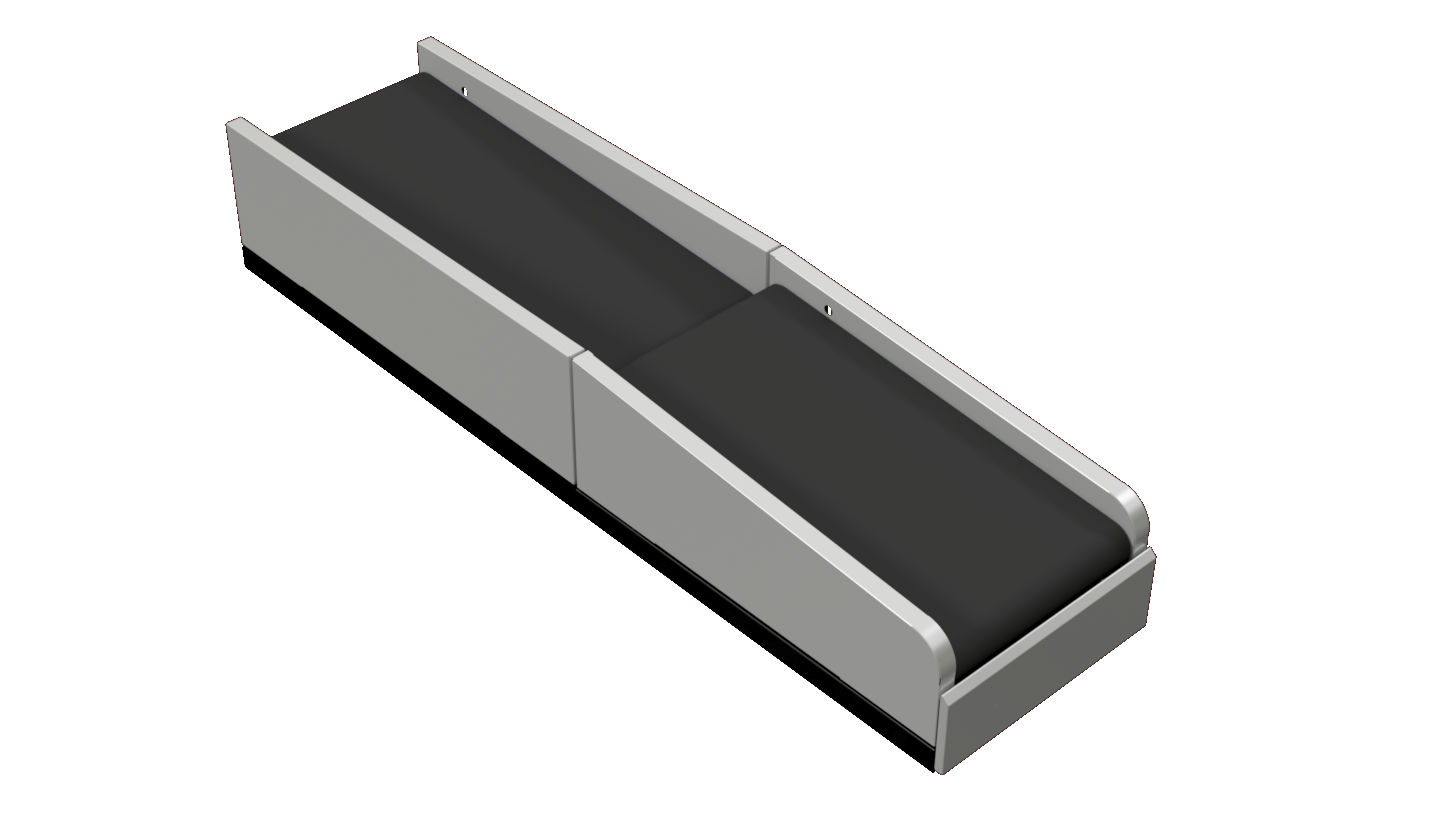
Types of Check-in Conveyors
Single Stage: Used to weigh, label, and dispatch the bag onto the collector/takeaway conveyor.
Two Stage: Baggage weighing and labeling operations are carried out on the scale conveyor, then transferred to the induct conveyor for accumulation/queuing before induction onto the collector/takeaway conveyor.
Three Stage: Separate conveyors are used for weighing, labelling and dispatch of the bags for maximum flexibility. Baggage weighing operations are carried out on the scale conveyor and then transferred to the labelling conveyor for attaching of the bag tag. The bag is then transferred onto the induct conveyor for accumulation / queuing and controlled induction onto the collector / take-away conveyor.
Key Features
- High-quality stainless steel finish.
- Roll-in/roll-out for ease of maintenance and cleaning.
- Fitted with quick-disconnect plugs.
- Easy removal of side panels with no tools required.
- Passenger tamper-proof weigh scale.
- Waterfall effect to assist baggage transfer between conveyors.
Technical Specifications
- Drive Pulley: Crowned 113mm diameter with a 0.37kW internal motor providing a conveyor speed of 0.5m/sec.
- End Roller: Crowned 90mm diameter roller with precision ball bearings and grease-packed sealed bearings.
- Cladding: 2mm thick 304 grade stainless steel with a brushed finish.
- Side Panels: Folded construction with aesthetically pleasing radius front edges.
- Belt: Flame retardant two-ply PVC, offered with both vulcanized and mechanical lacing depending on customer preference.
Transport Conveyor
The transport conveyor is designed to transport baggage throughout the terminal smoothly and efficiently. It is designed to handle product horizontally and at any degree of incline / decline up to a maximum 18° angle where elevation changes are required.
General transport conveyor is made up of several different modules bolted together to form a single conveyor.
Whilst the design of the conveyor modules has been standardised, it allows for many different configurations of length, top of belt height and incline / decline angle.
Low side panel height sections are also available to suit loading and unloading conveyor as well as collector conveyor configuration.
General Dimensions
Intermediate Module
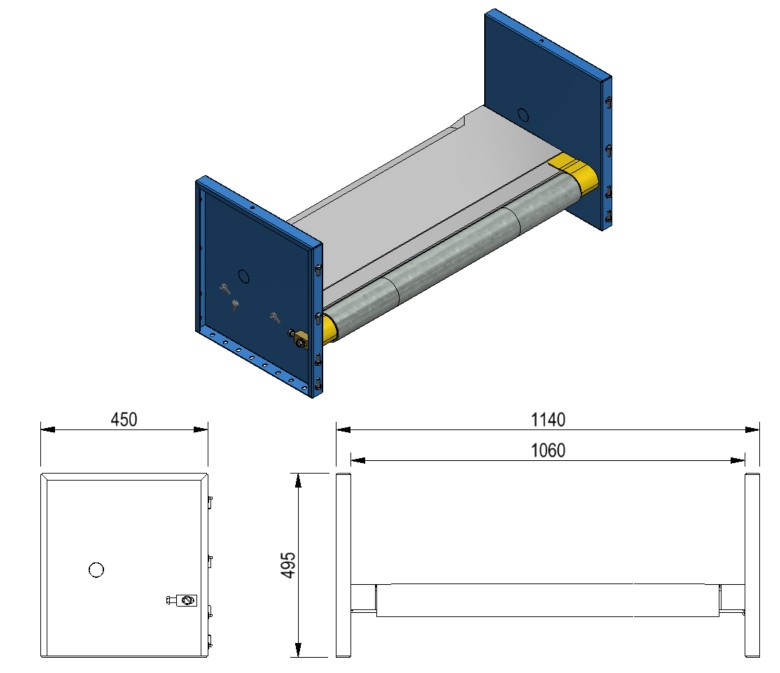
Drive Unit Module
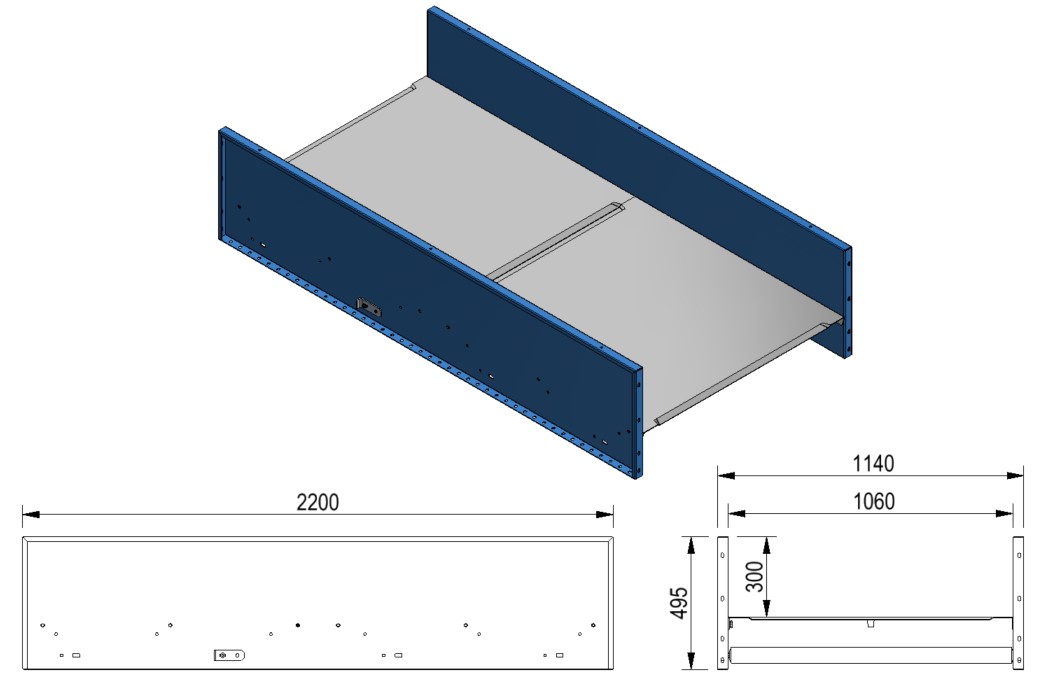
Breakover Module (10° shown)
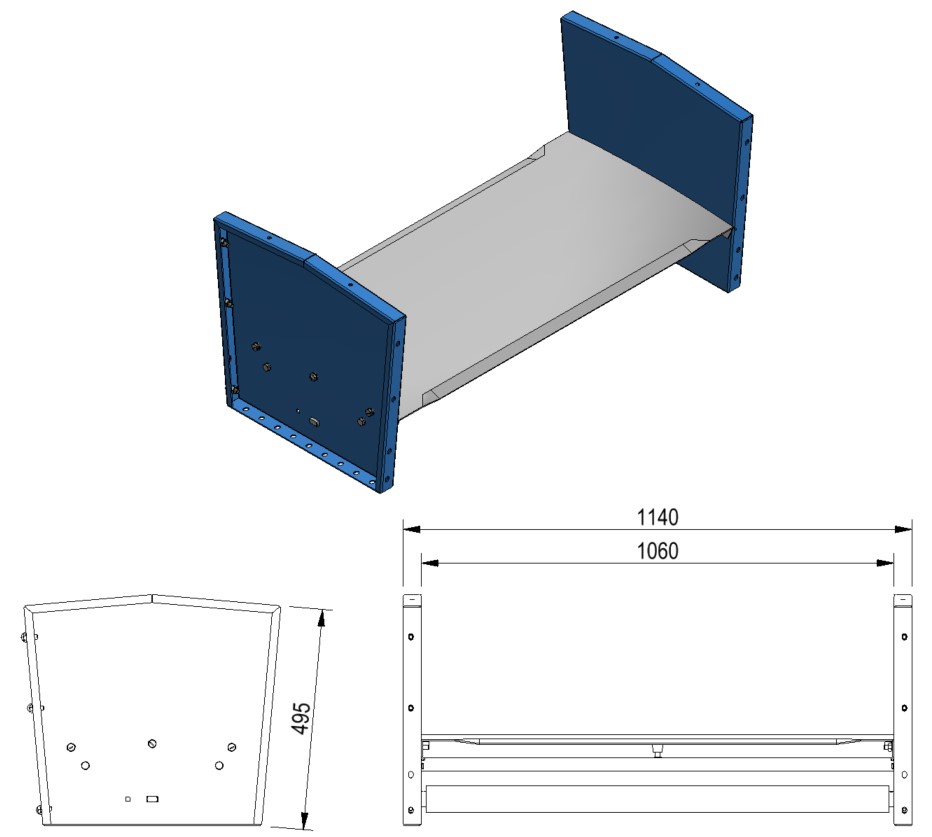
Drive Unit Module
Parts of Transport Conveyors
Head / Tail Module: Is used at both ends of the conveyor and houses the end rollers.
Drive Unit: Accommodates the motor gearbox and provides the drive and take-up of the conveyor belt.
Intermediate Section: Standard sections are 2200 mm and 1100 mm long however, special length sections are made to suit the required conveyor length.
Breakover or Decline: Used when a change to an incline is required and provides a smooth transition due to the large 3000 m radius.
Key Features
- End rollers with profiled finger guards to eliminate trap points for personnel and product.
- Final drive between the gearbox and drive pulley is via a direct shaft mounted gearmotor.
- Screw type belt take-up design to allow adjustment from one side.
- Internal bearings are fitted to head, tail and take-up rollers for ease of maintenance and quick changeover.
- Cut outs are provided in the conveyor frame to allow for rollers to be removed from the side.
- Can be floor mounted to as low as 300 mm top of belt.
Technical Specifications
- Intermediate Side Frames: The conveyor frame is typically 495 mm H x 40 mm W channel construction formed from 3 mm thick powder coated mild steel.
- Slider Beds: The slider bed is constructed from 3 mm galvabond mild steel set between the channel frames and rigidly braced with galvabond mild steel cross braces.
- Drive Frame: 5 mm thick mild steel formed channel 290 mm deep with 40 mm flanges.
- Breakover: A heavy duty return roller is used at the change of belt direction that is 60 mm in diameter with 5 mm nominal wall thickness mild steel tubing.
- Belting: To suit individual projects. Typically smooth top belting is used on collector conveyors.
Metering Conveyor
The metering conveyor is generally used as a queuing conveyor prior to conveyor junctions, merges or places where accumulation or separation is required.
The conveyor is designed to cope with frequent stop /starts.
Whilst the basic design of the conveyor is standard, it is sufficiently flexible to accommodate variations in belt type, sidewall height, overall length and conveying speed.
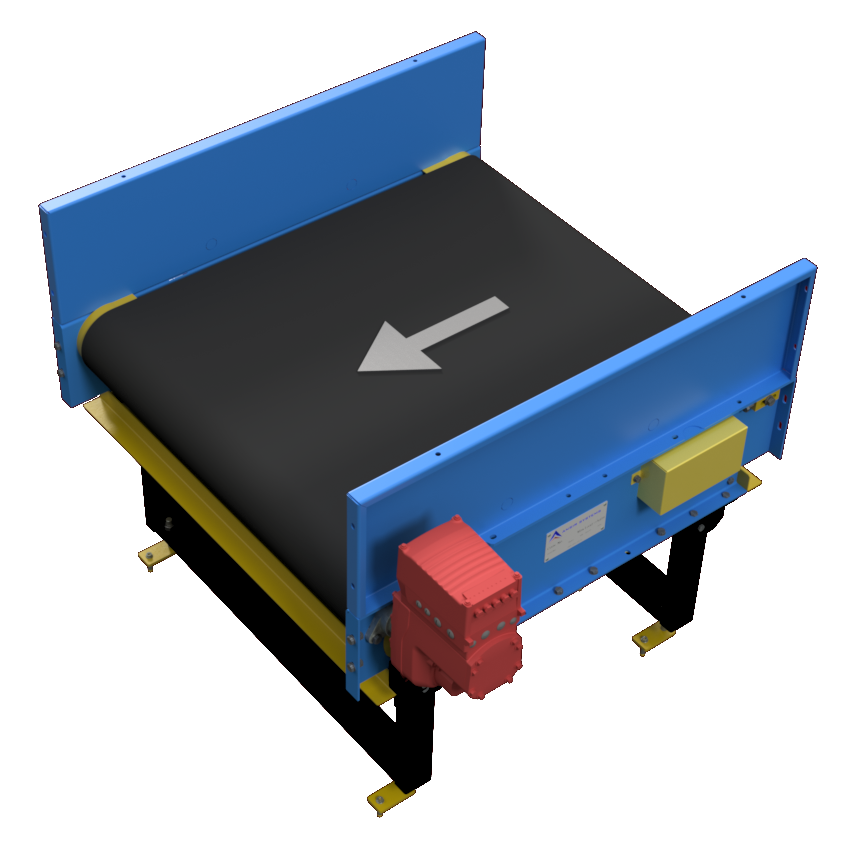
General Dimensions
Metering Conveyor
Key Features
- End rollers with profiled finger guards to eliminate trap points for personnel and product.
- Internal bearings are fitted to head, tail and take-up rollers for ease of maintenance and quick changeover.
- Final drive between the gearbox and drive pulley is via a direct shaft mounted gearmotor.
- Cut outs are provided in the conveyor frame to allow for rollers to be removed from the side.
- Screw type belt take-up design to allow adjustment from one side.
- Flexible design that allows for variations in length up to 2500mm. The standard metering conveyor is typically 1200 mm in length.
Technical Specifications
- Frame: 5 mm thick mild steel formed channel 290 mm deep with 40 mm flanges.
- End Roller: Machined crowned 90 mm diameter 6 mm nominal wall thickness mild steel tubing with UCS208 press fit, internally mounted, grease packed, sealed for life, precision bearings that mount to a non rotating 40 mm bright steel shaft.
- Motor / Gearbox: A shaft mounted motor gearbox connects directly to the conveyor drive roller shaft. The transmission equipment is adequately sized for the load, speed, temperature and operating conditions specified.
- Side Guides: 3.0 mm mild steel formed to a height of 300 mm above the conveyor bed and rigidly fastened to the conveyor. Guides are installed to eliminate any interference with baggage flow and to prevent damage.
- Belting: 2505 x 1000 mm LG endless PVC fire rated belt (typical for 1200 mm long conveyor).
Merge Conveyor
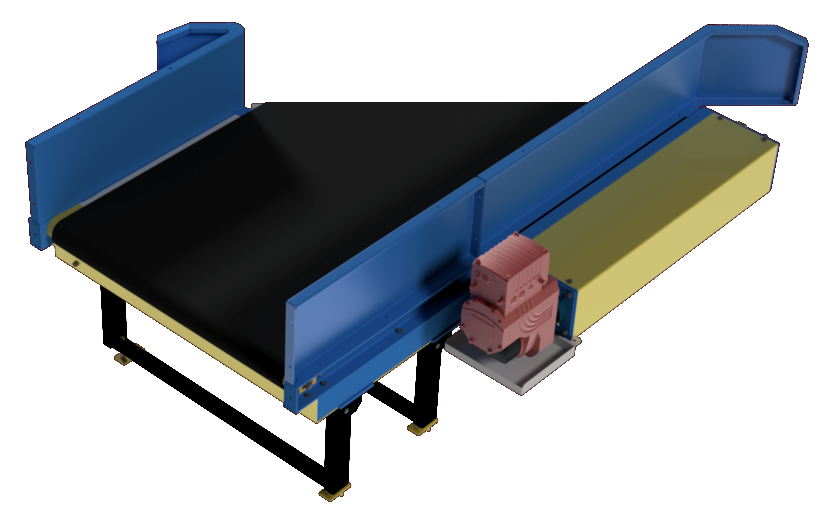
A merge is a belt conveyor with a 45° angled connection edge that enables the merging of two conveyor lines. Typically used with additional sorting conveyors they provide for a smooth flow of baggage from one line to another.
45° merge conveyors are manufactured in 2 lengths measured along the centreline of the conveyor from the tail end to the discharge / head end. They can be provided at either 1500 mm or 1775 mm centre length.
General Dimensions
Merge Conveyor
Key Features
- Tail end roller with profiled finger guards to eliminate trap points for personnel and product.
- Internal bearings are fitted to tail and take-up rollers for ease of maintenance and quick changeover.
- Final drive between the gearbox and drive pulley is via a direct shaft mounted gearmotor.
- Hinged front section that allows the use of an endless belt.
- 30mm dia nose bar reduces transitional gap between merge and receiving conveyor. Machined flat on face reduces contact patch between the belt and nose bar.
Technical Specifications
- Frame: Two separate frames are constructed with the front 45° frame section hinge mounted to allow for an endless belt to be fitted. The frame is powder coated finish.
- Head Nose Bar: The front non-rotating nose bars are made from 32 mm diameter bright steel bar with a machined flat that provides an airgap between the belt for reduced friction and cooling. The nose bars are fastened to the frame with a series of counter bored 5 mm cap screws. grease-packed sealed bearings.
- Motor / Gearbox: A shaft mounted motor gearbox connects directly to the conveyor drive roller shaft. The transmission equipment is adequately sized for the load, speed, temperature and operating conditions specified.
- Side Guides: 3 mm mild steel formed to a height of 300 mm above the conveyor bed and rigidly fastened to the conveyor. Guides are installed to eliminate any interference with baggage flow and to prevent damage.
- Belting: 4920 x 1000 mm LG endless PVC fire rated belt.
Crescent Pallet Carousel (1000W)
The carousel is designed to recirculate baggage on a continuous basis until it is removed from the conveyor. The crescent pallet carousel can be used as an arrivals carousel or make-up loop.
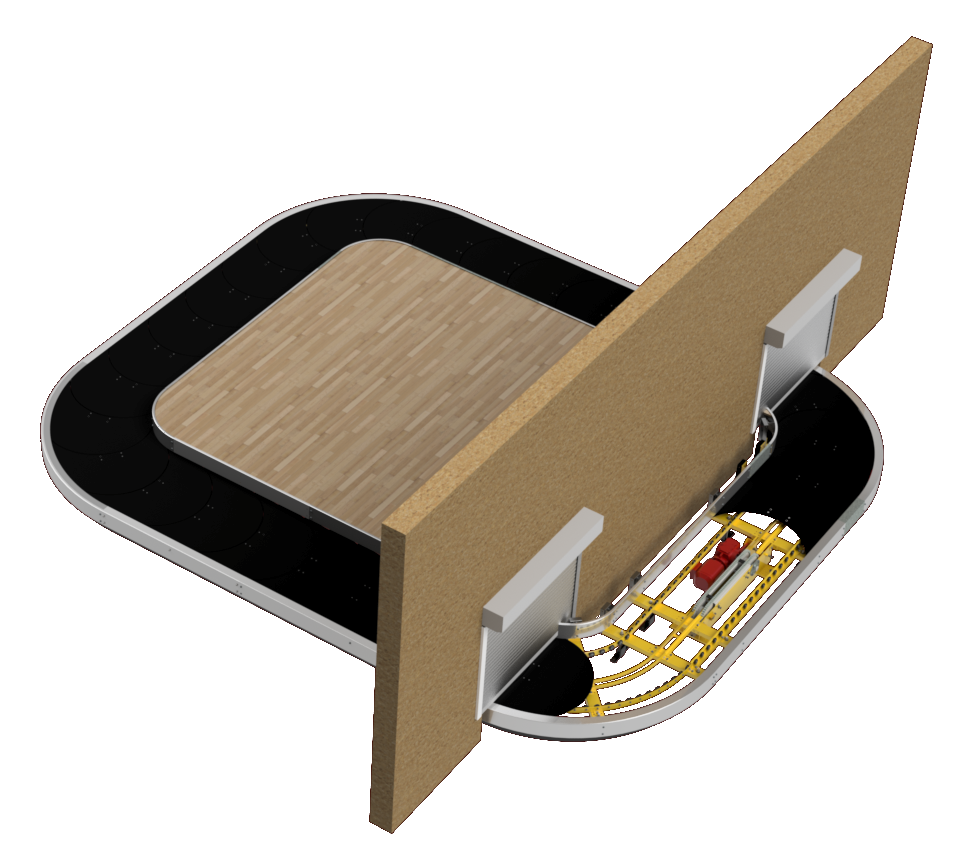
Whilst the design of the conveyor modules has been standardised, it allows for many different configurations length and pallet height to suit different applications.
General Dimensions
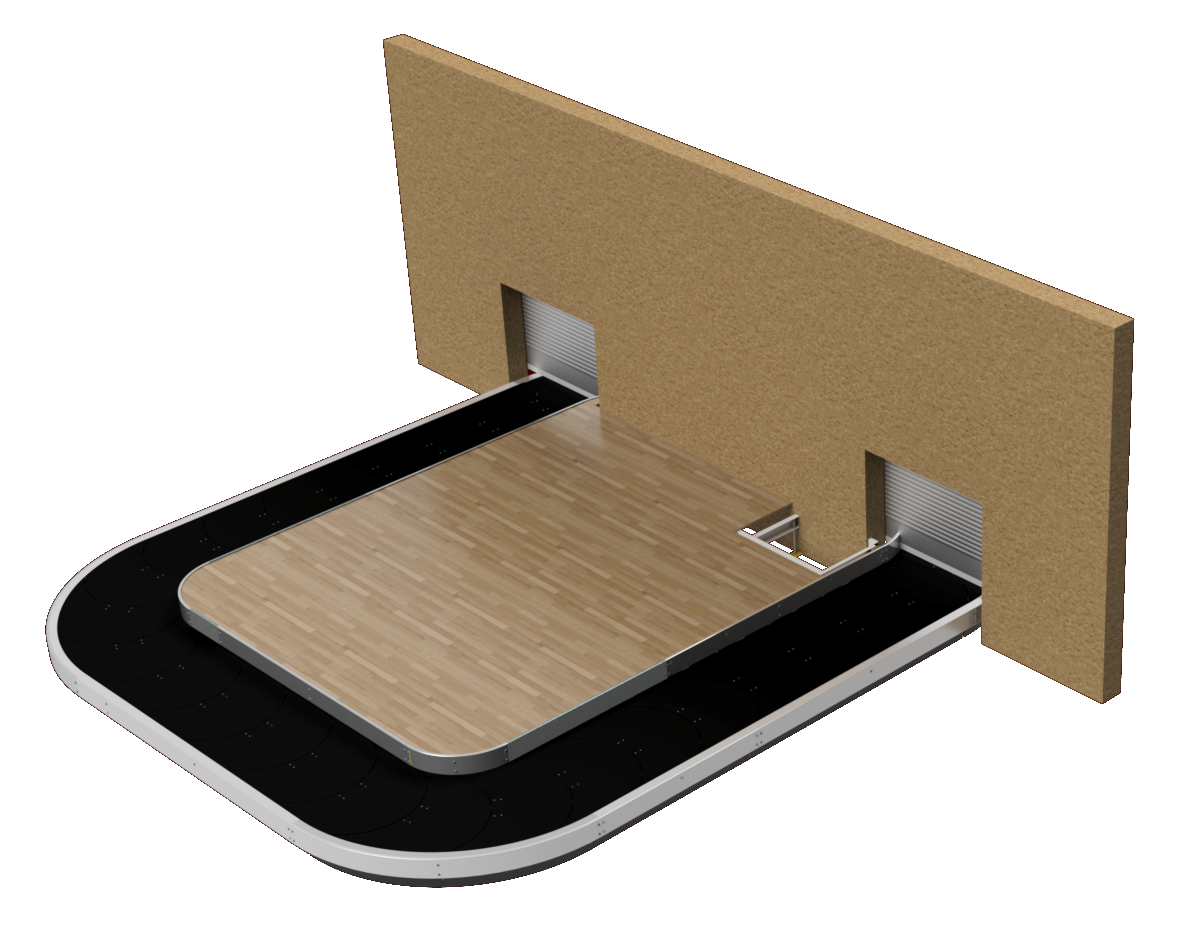
Types of Crescent Pallet Carousels
Arrivals Reclaim Carousel: Typically, 320 mm in height to allow for easy removal of baggage. Stainless steel clad in passenger area.
Departures Make-up Carousel: Located airside. Typically 600 mm to 800 mm in height to allow for easy unloading of baggage into / onto a container / trailer. Galvabond or powder coated finish.
Key Features
- Caterpillar drive to ensure positive engagement at all times.
- Direct shaft mounted gearmotor provides drive to the sprockets.
- Low minimum conveyor height of 310mm.
- Sealed for life bearings used throughout in order to minimise maintenance.
- Modular components provide flexibility in design and future expansion.
Technical Specifications
- Drive Unit: Caterpillar drive unit floor mounted and consists of a gearmotor sized to suit the required drive. The gearmotor is shaft mounted directly to the drive head shaft.
- Frame: Fabricated mild steel construction with M16 threaded rod for vertical adjustment and precise levelling. A sound, reasonably level floor is required for simple installation and fixing.
- Cladding: 2.5 mm thick 304 grade stainless steel with #4 finish horizontal grain on surfaces exposed to public view. 3 mm powder coated or galvabond mild steel airside.
- Conveyor Pallet: Crescent shaped polyurethane covered, steel or wooden composite core accurately moulded to maintain correct relationship between segments when negotiating turns.
Overlapping Slat Carousel
The carousel is designed to recirculate baggage on a continuous basis until it is removed from the conveyor. The overlapping slat carousel can be used as an arrivals carousel or make-up loop.
Whilst the design of the conveyor modules has been standardised, it allows for many different configurations of length and top of belt height to suit different applications.
General Dimensions
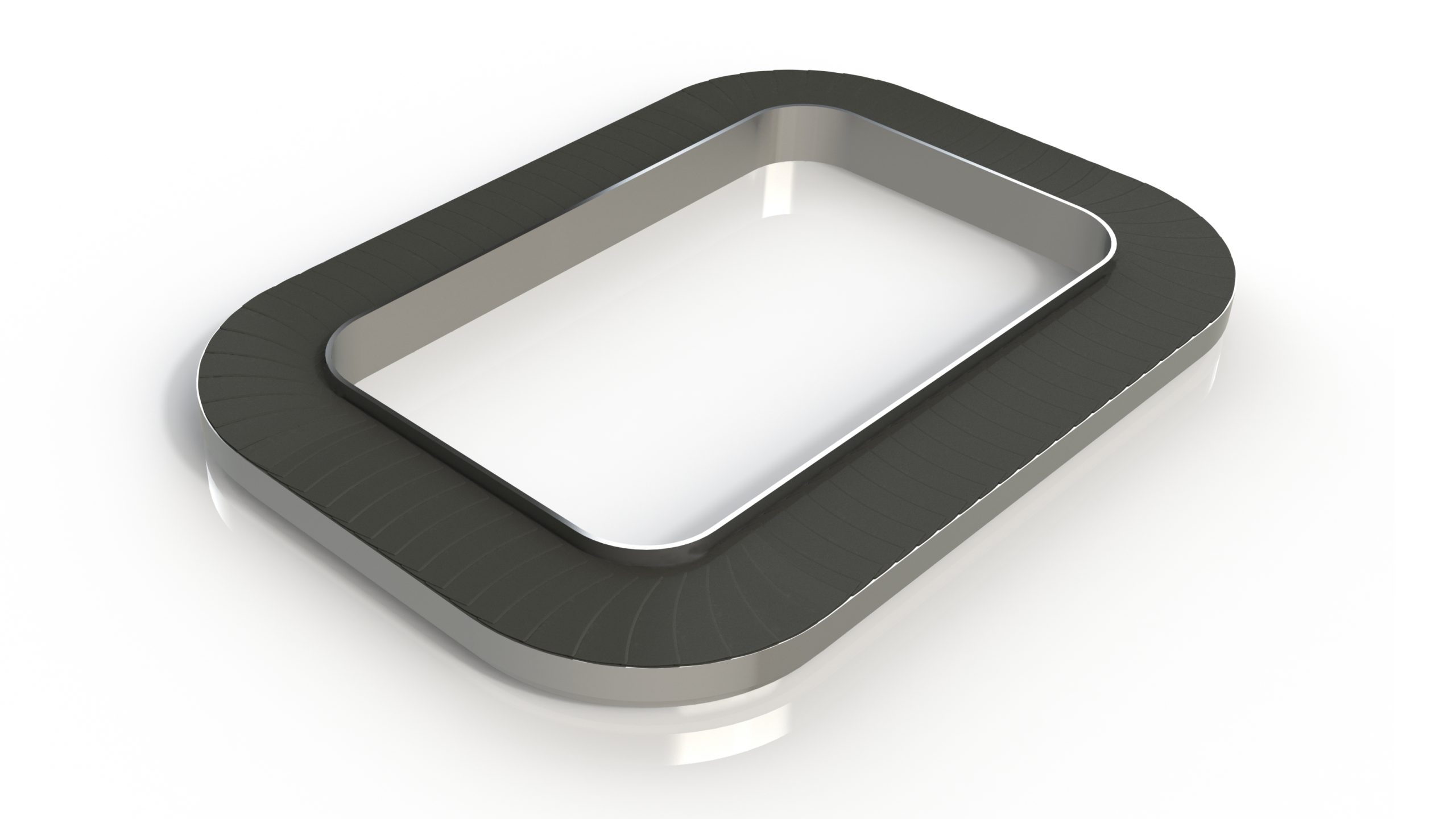
Types of Overlapping Slat Carousels
Arrivals Reclaim Carousel: Typically, 410mm (top of slat) in height to allow for easy removal of baggage. Stainless steel clad in passenger area.
Departures Make-up Carousel: Located airside. Typically 600 mm to 800 mm in height to allow for easy unloading of baggage into / onto a container / trailer. Galvabond or powder coated finish.
Key Features
- Lightweight and innovative construction
- Glass reinforced composite drive chain.
- Reduced energy consumption and Recyclable materials.
- Flame retardant slats.
- Low Noise (friction drive).
- No tools required for slat installation or removal.
Technical Specifications
- General: Live Load (Peak) 150 kg/m, Static Load (Max) 270 k/m, Noise Level 59dB(A), Standard Speed 0.3 m/s to 0.5 m/s (30 m/minute), Slats Flame retardant, Slat Width 1000mm
- Trim: Stainless steel (public area), Galvanised or powder coated mild steel (air side)
- Frame: Cross members 5mm mild steel, Side channels 3mm mild steel
- Carriage: Mild steel powder coated
- Chain Link: Made from glass reinforced composite. Each individual link has a cam adjustment take up of 5mm negating the need for site cut frame sections at installation.
Inclined Carousel
The carousel is designed to recirculate baggage on a continuous basis until it is removed from the conveyor. The Incline claim carousel can be used as an arrivals carousel or make-up loop.
Whilst the design of the conveyor modules has been standardised, it allows for different configurations in length and height to suit different applications.
A minimum conveyor height of 450mm can be achieved (measured to the top of the front trim). Inclined carousels are used to maximise the number of bags which can be stored on a unit.
General Dimensions
Drive Unit / Straight Module
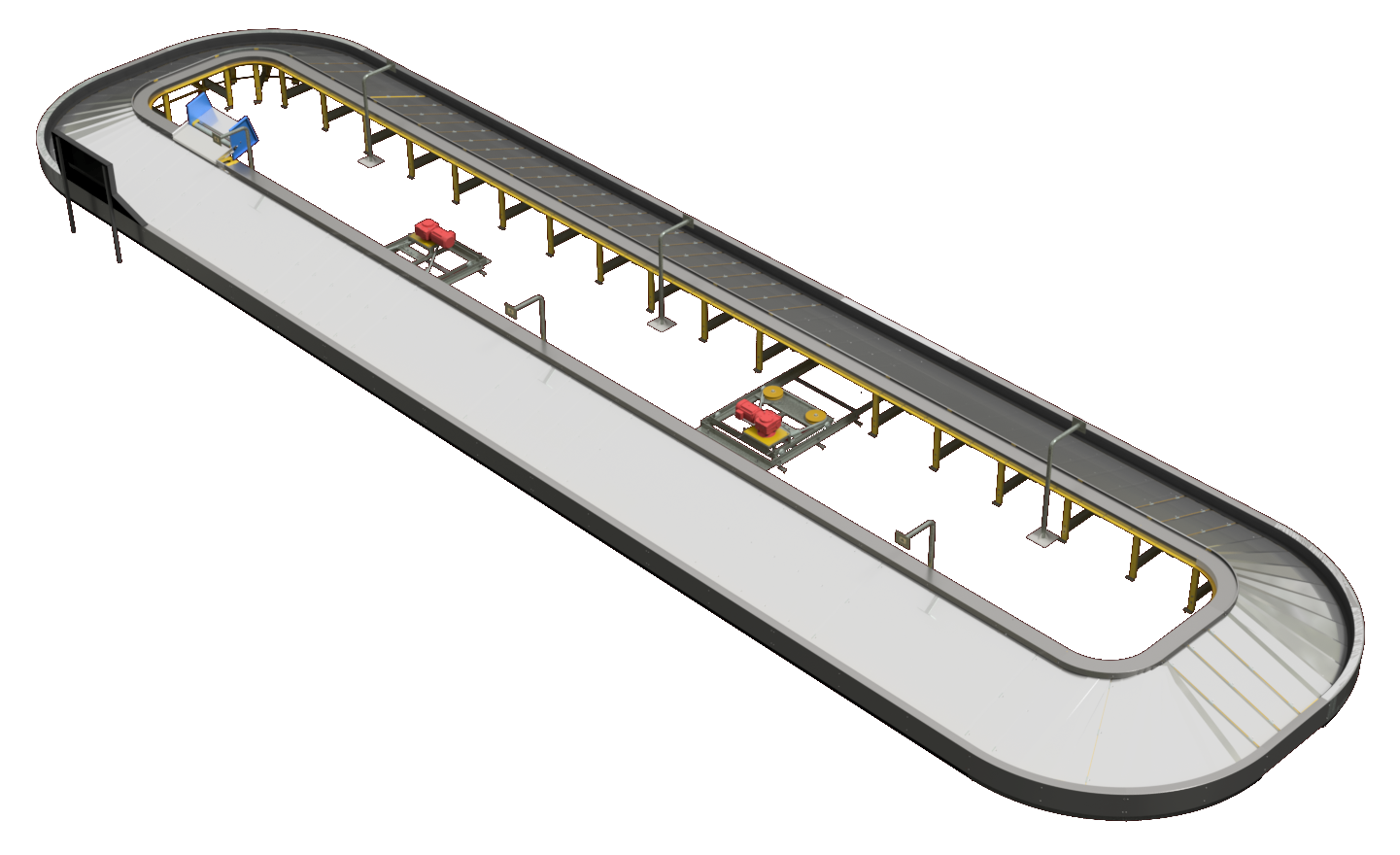
Types of Inclined Carousels
Arrivals Reclaim Carousel: Typically, 450mm in height to allow for easy removal of baggage. Stainless steel clad in passenger area.
Departures Make-up Carousel: Located airside. Typically 450 mm to 650 mm in height to allow for easy unloading of baggage into / onto a container / trailer. Galvabond or powder coated finish.
Key Features
- Fritction drive.
- Direct shaft mounted gearmotor provides drive.
- Sealed for life bearings used throughout in order to minimise maintenance.
- Modular components provide flexibility in design.
- Urethane coated load and guide wheels for quiet operation.
Technical Specifications
- Live Load (Peak): Crowned 113mm diameter with a 0.37kW internal motor providing a conveyor speed of 0.5m/sec.
Gravity Roller Conveyor
Non powered accumulation of baggage / product. The conveyor can be placed flat for manual movement of the bag along its length or slightly declined to let gravity slowly transit the bag.
Typical applications are:
- At the end of a make up lateral for accumulation.
- Manual processing areas to allow for the easy movement of baggage / product by the operator.
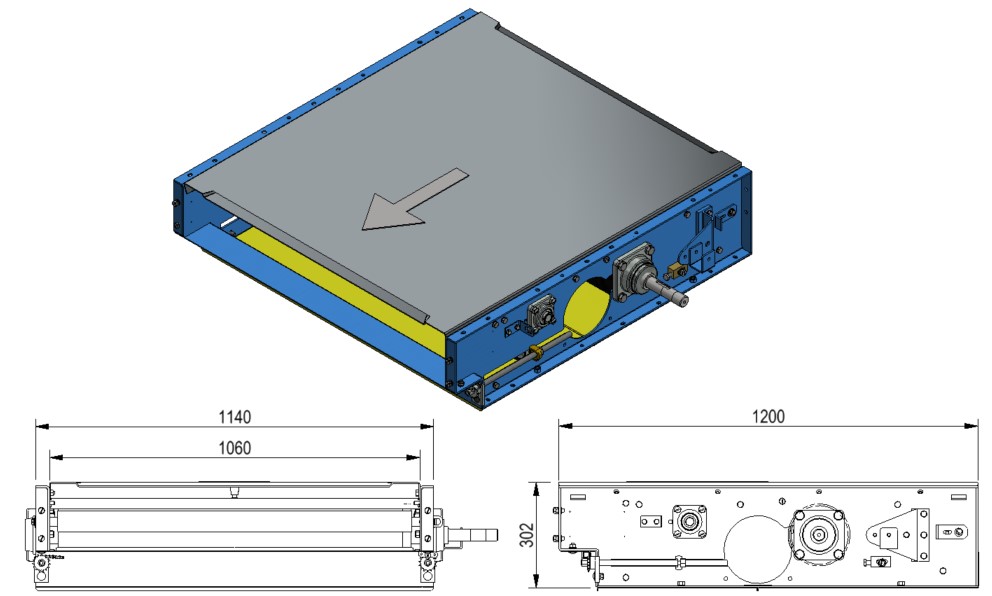
General Dimensions
Between Frame Rails (BFR)
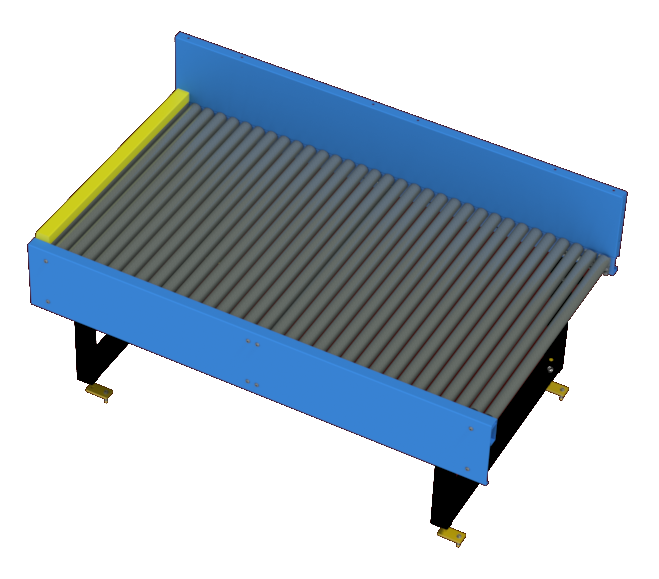
Types of Gravity Roller Conveyors
Between Frame Rails (BFR): Typically 1060mm to match standard powered conveyor widths. (1450 BFR with split rollers can be provided for oversize product).
Key Features
- Light weight and rigid conveyor frame. With safety edge fold. Cross bracing at approx. 900mm centers.
- Pop out rollers provided when butting up to a powered conveyor for safety.
- End stops provided as required to prevent baggage / product from falling off the conveyor.
- Powder coated conveyor frame and leg supports as standard (other finishes available on request).
- Individual sections up to 3000mm in length.
- Waterfall effect to assist baggage transfer between conveyors.
Technical Specifications
- Rollers: 50mm dia galvabond finish with semi precision bearings. Spring loaded hex shaft for ease of installation and removal
- Frame: 2.5mm mild steel, formed C-shaped channel 40mm x 90mmx 40mm.
- Supports: Folded mild steel construction with adjustable threaded rod feed for easy levelling and adjustment.
- Finish: Powder coated frame and supports.
Power Curve
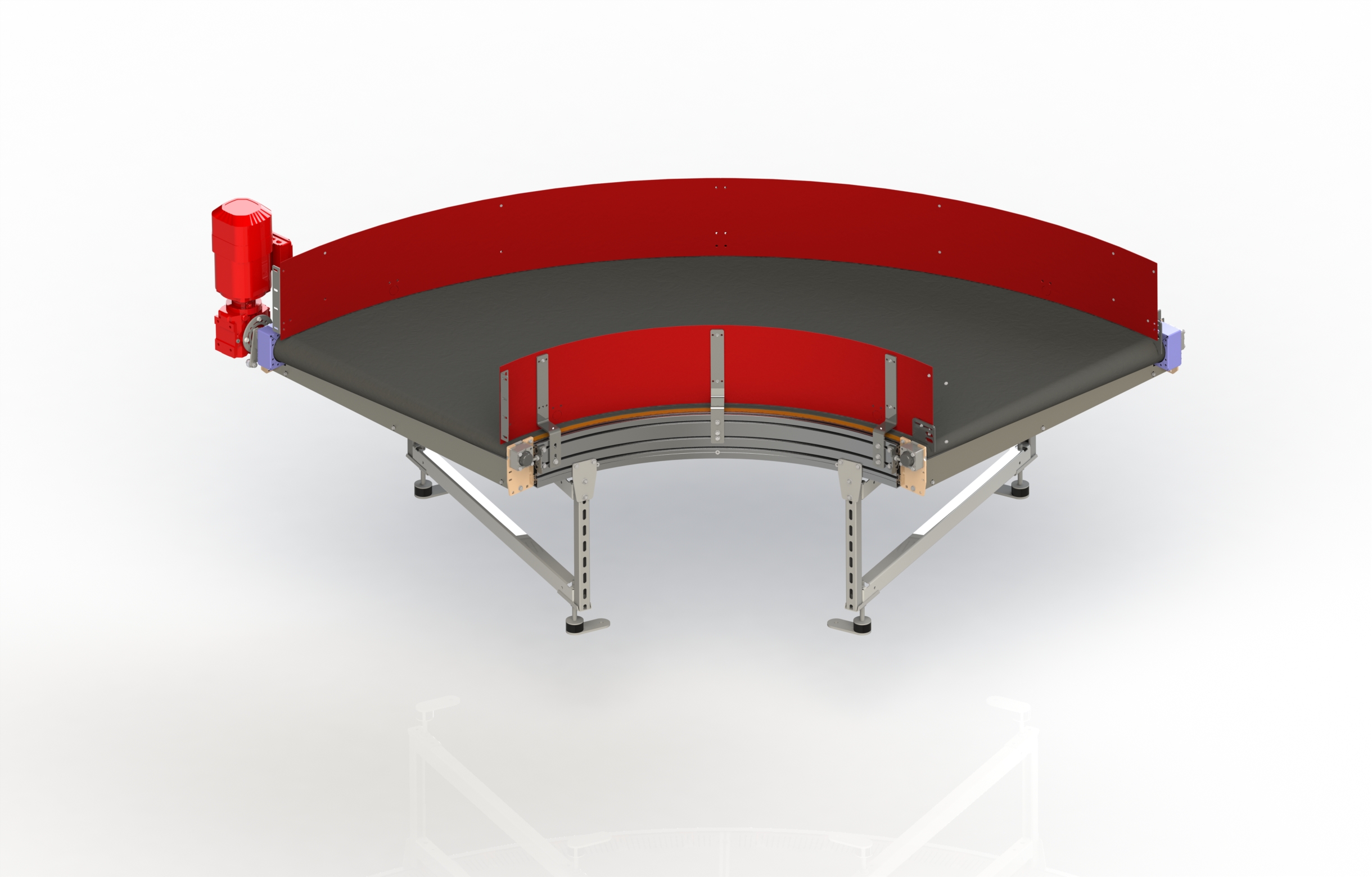
The curve conveyor is used to change direction within the conveyor system and provide a smooth flow of baggage.
General Dimensions
Power Curve
Key Features
- Standard angles: 15o, 30o, 45o ,90o ,120o , 135o and 180o. Other angles over 15° may be provided on request.
- Chain driven positive drive and no slippage.
- Quick belt change without removing the drive motor.
- Suitable for a wide range of temperatures when compared with other friction drive unit.
- Passenger tamper-proof weigh scale.
- Waterfall effect to assist baggage transfer between conveyors.
Technical Specifications
- Sort Rate: Conveyor speeds of more than 3 m/sec
- Centerline radius: Crowned 90mm diameter roller with precision ball bearings and grease-packed sealed bearings.
- Belt Width: 1060mm between side guides.
- Conveyor Belt: Flexam EF 10/2+A22 Black AS FR
- Maximum loading: 75kg per metre
Plough Divert
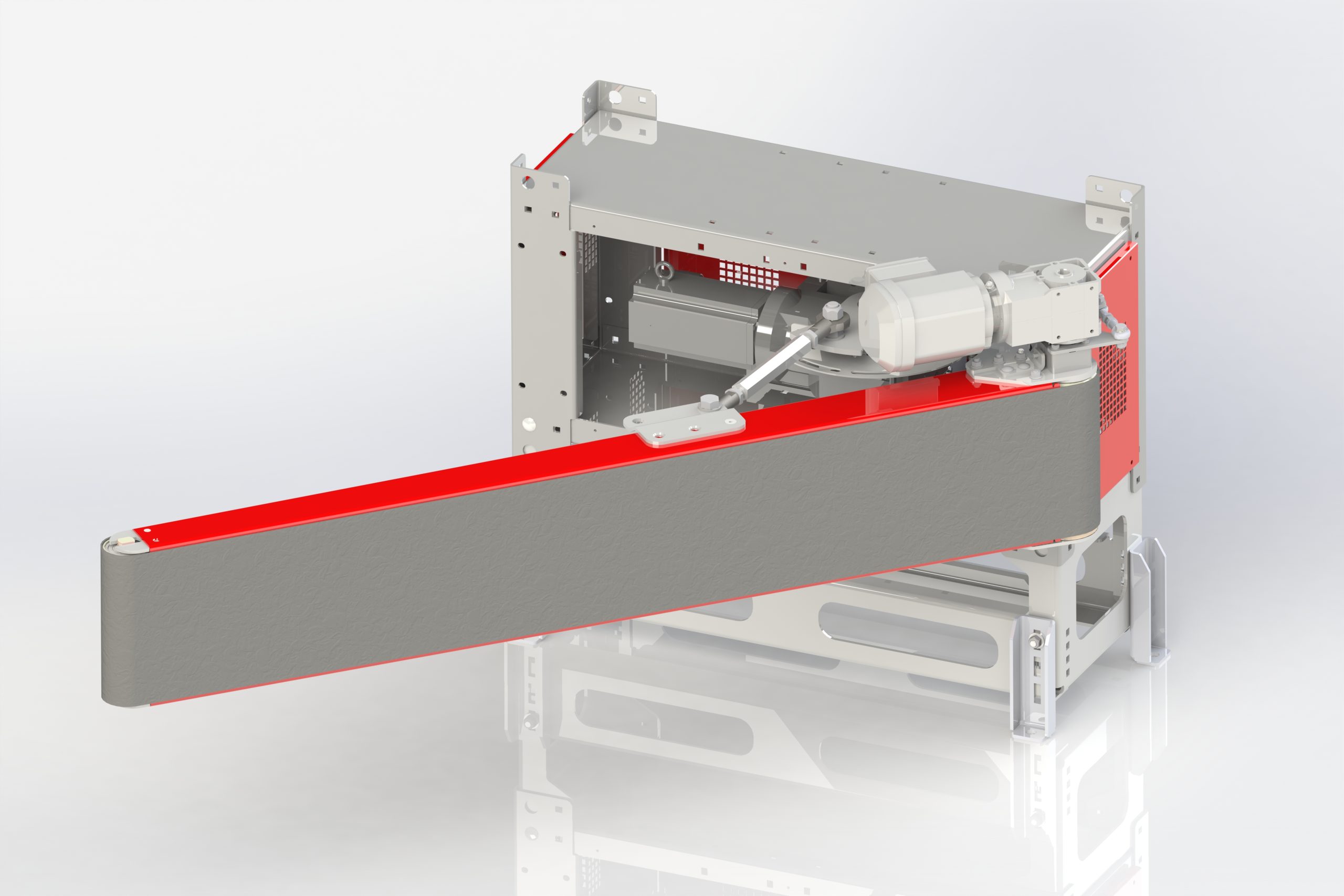
The Fast Acting Belt Plough has been designed to handle and sort a wide range of products, with minimum impact to the bag during the plough divert operation.
The unit has been design to be used in conjunction with the Ansir range of Transport and Queue conveyors and is of modular design enabling the unit to be supplied to suit the customer’s specific needs.
Fast Acting Belt Ploughs perform:
- Line splitting of flow from one line into two.
- Separation of single bags from a continuous stream of baggage.
- As an inline sortation system.
General Dimensions
Fast Acting Plough
Key Features
- Single horizontally mounted plough arm.
- Separate drive for divert mechanism and plough arm.
- Robust welded frame construction.
- Drive and end pulleys are fitted with grease packed precision bearings.
- 360° Motor rotation for one cycle which prevents plough arm over-run.
Technical Specifications
- Frame: Welded channel frame construction. The arm of the plough is of steel box section with a slider bed surface over which the plough belt runs. The diverter belt runs between vertically oriented drive and end pulleys. Belt tensioning is achieved by adjusting the end pulley.
- Plough Belt Drive: V-belt to absorb shock loading.
- Pulleys: The drive and end pulleys are fitted with precision bearings. The drive pulley is mounted on an extended drive shaft, which is driven by a geared motor.
- Drive Shaft / Divert Mechanism: A machined drive flange is fixed to the output shaft of the gearbox which in turn is connected through a link bar mechanism to the main pivoting shaft of the plough arm.
- Divert Mechanism – Motor Gearbox: A shaft mounted motor gearbox connects directly to the conveyor drive roller shaft. The transmission equipment is adequately sized for the load, speed, temperature and operating conditions specified. The drive flange completes 360° rotation of travel for one full plough cycle which prevents over-run.
- Sensors: A shaft mounted motor gearbox connects directly to the conveyor drive roller shaft. The transmission equipment is adequately sized for the load, speed, temperature and operating conditions specified. The drive flange completes 360° rotation of travel for one full plough cycle which prevents over-run.
Built for Reliable Airport Operations
Ansir Systems designs baggage handling solutions that deliver dependable performance, seamless passenger flow, secure operations and global integration with trusted industry partners.
Dependable Performance
From simple carousels to fully automated systems, our range of BHS products is designed to perform reliably and efficiently in demanding, high-pressure environments. With a focus on continuous improvement, we are committed to refining performance and functionality to reduce operational costs, minimise downtime and deliver long-term savings.
Seamless Passenger Experience
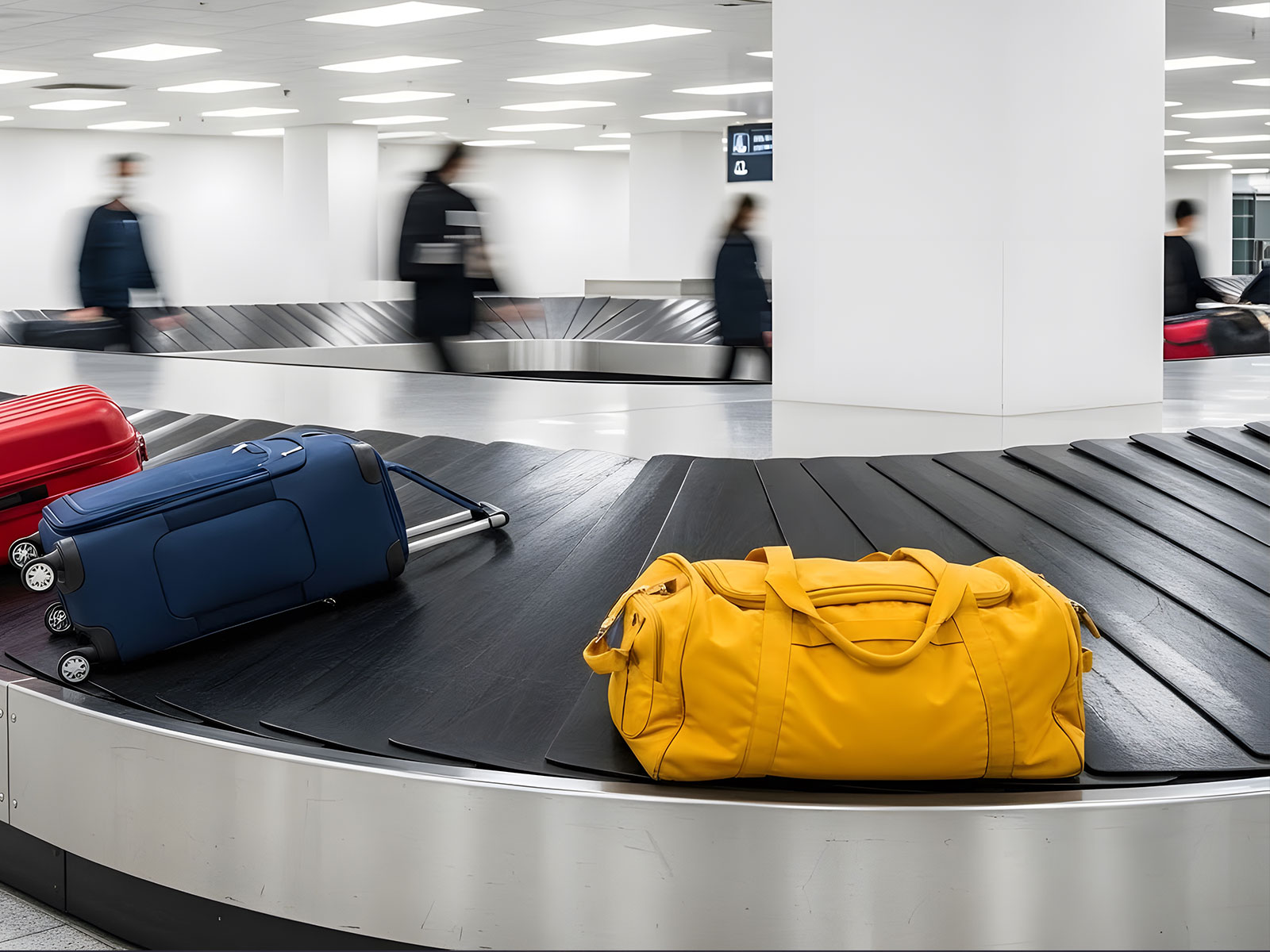
Flying can be a stressful experience for passengers. Our BHS products are designed to integrate seamlessly, ensuring a reliable flow of baggage from check-in to the aircraft and finally to the retrieval area. By maximising airport operations, we help reduce lost luggage, prevent potential flight delays and enhance overall passenger convenience and satisfaction.

Secure Operations
All Ansir Systems products are fully compliant with today’s stringent airport security regulations and aviation safety standards, ensuring the safety and wellbeing of passengers. Our BHS products integrate seamlessly with inline security systems, including EDS (Explosive Detection Systems), X-ray machines, and CT-based scanners. Additionally, our components are proudly manufactured to AS/NZS ISO 9001:2008 Quality Assurance standards.
Strategic Global Partnerships
To ensure the reliable performance of our baggage handling systems, we’ve partnered with leading global suppliers who provide specialised equipment, systems and parts for the airport and logistics industry. With Ansir Systems, you can trust that our solutions will integrate seamlessly with any third-party components.

Get In Touch
Discuss your airport BHS needs with one of our experts today.